East Village
City of GodThe East Village is the Manhattan neighborhood that anchors the novel's central mystery, the place where the Reverend Thomas Pemberton's church, St. Timothy's Episcopal, stands and from which its eight-foot brass cross is stolen, only to reappear on the roof of the Synagogue of Evolutionary Judaism. It is a dense, shabby, and economically mixed quarter of the old Lower East Side, a world of tenements, small storefronts, and people just getting by, whose character is defined against the grander, sunnier districts to which Manhattan's wealthier residents long ago migrated. The neighborhood is not merely a setting but a social and spiritual ground, the place where the novel's religious drama is staged and where its narrator repeatedly returns to measure the city's life.
A Neighborhood of the Old Lower East Side
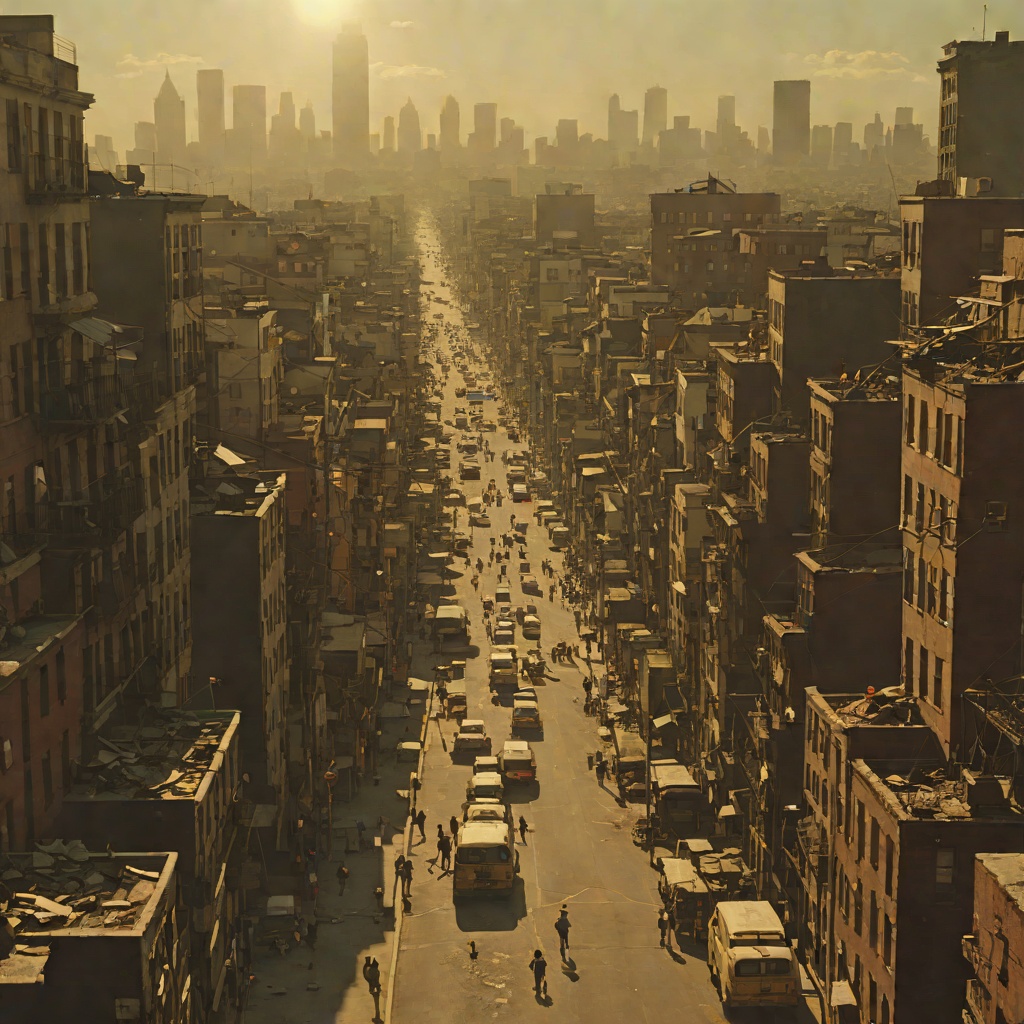
The East Village is introduced as a relic of an older Manhattan, a place where, in the old days, there had to have been at least one church's worth of WASPs before the city moved north to the sunnier open spaces above Fourteenth Street. St. Timothy's itself is described as a typical New York Brownstone Ecclesiastic, a little brother of the grander Church of the Ascension on lower Fifth Avenue, and the narrator, acting like the art director of a movie, deliberately places it off Second Avenue, around the corner from the Ukrainian hall and restaurant. The neighborhood is jammed in between tenements, its street at each end colored up with the signs of rent-payers—cleaners, bodegas, bars, and check-cashing storefronts—and its few gravestones in the patchy grass have sagged over the years like shoulders bowed in grief. The people on its corners reflect the same economic strain: a young T-shirted girl running in place with her Walkman, a gray-haired over-the-hill bohemian affecting a ponytail, a squat short Latina, a stooped old man in house slippers with a Yankees cap and filthy pants held up by a rope, and a young black man crossing against the traffic, glaring and imperious. The narrator notes that the neighborhood is full of coded ethnic and social enclavists, multiculturally suspicious and verbally aggressive, as if the city as an idea is too much to bear even by the people who live in it.
The Site of the Cross Theft and Recovery
The East Village is the scene of the novel's central event: the theft of the brass cross from behind the altar of St. Timothy's. The narrator, fumbling with a searchlight, discovers the cross gone, leaving only a shadow of the crucifix in the unfaded paint of his predecessor's poor taste. A detective from the precinct dismisses the cross's value, telling the priest that thieves would hit a synagogue for the Torah, which could bring a minimum of five thousand dollars, whereas the book value of the cross is zilch, nothing but scrap metal on the street. The cross's recovery, however, takes the narrative across the neighborhood's boundaries and up to the roof of the Synagogue of Evolutionary Judaism, where the rabbi, Joshua Gruen, leads the winded Pemberton up an iron ladder and through a trapdoor to find the eight-foot hollow brass cross lying flat on the black tarred roof, its transverse exactly parallel to the front of the building, its upright pressed against the granite pediment, tarnished and shining in the autumn sun. The old nicks and dents on the cross are visible up close, and Pemberton admits he had known he'd found it from the moment he heard the rabbi's voice.
A Theater of the City's Life
Beyond its role in the mystery, the East Village serves as a stage for the narrator's observations of urban existence. Walking its streets, the narrator records the vivid particulars of the neighborhood's commerce and daily life: the farmers' market at Union Square with its banks of potted flowers and brilliant color fields of pears and apples, the cheap clothes hanging from pipe racks on the sidewalk, the big hand-crayoned sale signs in the windows, and the tables with hats and gloves for the coming winter. The narrator's walks take him past the paranoidally fenced community gardens, the towered Romanesque strawberry-red Jefferson Market Courthouse, and down miserable, wretched Eighth Street, once the glory of bohemian intellect with the best bookstore in New York, now the venue of shoes and phony antique clothing. The neighborhood is also a place of transformation and loss: by the time of the narrator's later visits, St. Timothy's itself has been converted into a theater company, with Gothic lettering over the doors reading Theater of St. Tim's, and they are playing Chekhov's The Seagull. The church, once a place of worship, has become a venue for performance, its graves now part of the theatrical set.
The Human Need to Walk Among Strangers
The East Village, and the city of which it is a part, embodies the narrator's meditation on the human need to walk among strangers. Standing on a corner at the intersection of two busy streets, the narrator sees thousands of lives headed in all four directions, on foot, on bikes, on in-line skates, in buses, strollers, cars, and trucks, with the subway rumble underneath his feet. He reflects that the city may begin from a marketplace, a trading post, or the confluence of waters, but it secretly depends on the human need to walk among strangers, and that each passerby—every scruffy, oversize, undersize, weird, fat, bony, limping, muttering, or foreign-looking person—is a New Yorker, as native to this diaspora as the narrator himself, part of a great sputtering experiment in a universalist society proposing a world without nations where anyone can be anything and the ID is planetary. This vision of the city as a collective organism is extended in the narrator's observations of the natural world within the urban fabric, from the brown ants building an underground city in Central Park to the birds of Valdemingomez, and it is against this backdrop of teeming, interconnected life that the novel's religious questions are posed. The East Village, with its particular density of struggle and survival, is the most concentrated expression of this urban condition, the place where the sacred and the profane, the church and the tenement, the grave and the theater, all coexist within a few blocks.